


Forscherin und Wissenschaftlerin
Ulrike Kindl ist eine lebendige und unermüdliche Geschichtenerzählerin.
Geboren 1951 in Meran, ist sie Germanistin und Mediävistin und war lange Zeit als Professorin in der Fakultät für Sprachwissenschaften der Universität Ca’ Foscari in Venedig tätig. Ihre Forschungsschwerpunkte liegen in der mittelalterlichen Philologie und der Kulturanthropologie sowie in der symbolischen Ikonografie und der alpinen Volkskunde. Zu ihren jüngsten Publikationen zählt das dreibändige historische Werk Il codice Brandis (mit A. Baccin, Tangram 2018–20). Für den Verlag Edizioni Alphabeta Verlag gab sie die Erzählungen von Anita Pichler Le donne di Fanis (2020) heraus.
Ulrike Kindl ist seit vielen Jahren eine enge Freundin der BAU Community. Jede Begegnung mit ihr eröffnet wissenschaftliche Perspektiven und Denkansätze, die volkstümliche Traditionen und alpine Mythologien miteinander verweben und die Landschaft in Erzählung verwandeln. Im Jahr 2021 verfasste sie den Beitrag „Alpine Rockscapes“ zur geologischen Entstehung der Dolomiten für The Chestnut, the Sea Urchin & the Tuning of the Bells von Futurfarmers, ein Märchen, das aus vielen Händen entstanden ist.
Ebenfalls 2021 arbeitete sie mit der Künstlerin Katrin Hornek zusammen, die als Artist in Residence bei BAU tätig war und dank Ulrikes Beitrag Themen rund um die Fruchtbarkeitsmythologien der Landschaft vertiefen konnte.
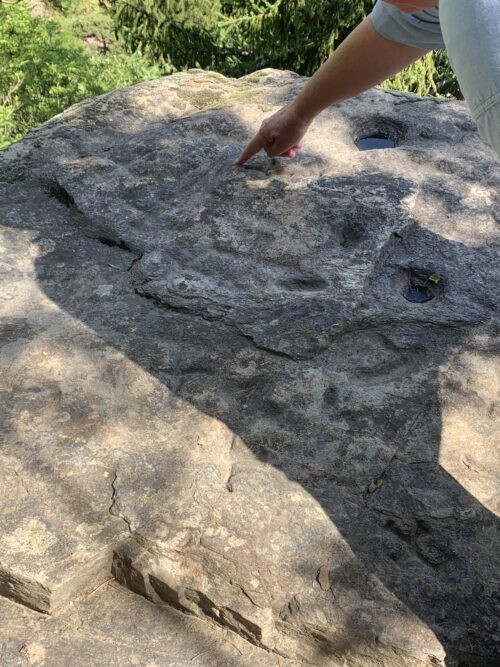
Im Jahr 2025 teilte sie mit BAU ihr Wissen über die Menhire von Algund und trug zur Publikation “The Taste of Future Landscapes”, bei, die anlässlich des zehnjährigen Bestehens von BAU realisiert wurde.
Folklorist and professor
Ulrike Kindl is a vibrant and generous storyteller.
Born in Merano in 1951, she is a scholar of German studies and medieval literature and was for many years a professor at the department of Linguistic Sciences at Ca’ Foscari University of Venice. Her research focuses on medieval philology and cultural anthropology, as well as symbolic iconography and Alpine folklore. Among her most recent publications is the three-volume historical work Il codice Brandis (with A. Baccin, Tangram 2018–20). For Edizioni Alphabeta Verlag, she edited Anita Pichler’s stories Le donne di Fanis (2020).
Ulrike Kindl has been a close friend of the BAU Community for many years. Every conversation with her opens up scientific insights and perspectives that interweave folk traditions and Alpine mythologies, transforming the landscape into narrations. In 2021, she wrote the contribution “Alpine Rockscapes” on the geological formation of the Dolomites for The Chestnut, the Sea Urchin & the Tuning of the Bells by Futurfarmers, a fairytale created through many hands.
In 2021, she collaborated with Katrin Hornek, an artist in residence at BAU, whose exploration of themes related to the landscape’s fertility mythologies was deepened through Ulrike’s contribution.
In 2025, she shared her knowledge of the menhirs of Lagundo with BAU and contributed to the publication “The Taste of Future Landscapes”, produced on the occasion of BAU’s 10th anniversary.
Studiosa di tradizioni popolari e professoressa
Ulrike Kindl è una raccontastorie vivace e generosa.
Nata a Merano nel 1951 è una germanista e medievista che a lungo è stata una docente presso l’Università Ca’ Foscari di Venezia nel dipartimento di Scienze del Linguaggio. Si occupa di filologia medioevale e antropologia culturale, nonché di iconografia simbolica e folclore alpino. Tra le sue ultime pubblicazioni ricordiamo l’opera storica in tre volumi I (con A. Baccin, Tangram 2018-20). Per Edizioni Alphabeta Verlag ha curato i racconti di Anita Pichler Le donne di Fanis (2020).
Ulrike Kindl è da anni un’amica cara alla comunità BAU. Ogni conversazione con lei si apre su spunti e visioni scientifiche che intrecciano tradizioni popolari e mitologie alpine, trasformando il paesaggio in narrazione. Nel 2021 ha scritto il contributo “Alpine Rockscapes” sulla formazione geologica delle Dolomiti per “The Chestnut, the Sea Urchin & the Tuning of the Bells di Futurfarmers”, fiaba nata da molteplici mani.
Nel 2021 ha collaborato con Katrin Hornek, artista in residenza presso BAU, che, grazie al contributo di Ulrike, ha approfondito tematiche legate alle mitologie della fertilità del paesaggio.
Nel 2025 ha condiviso con BAU le sue conoscenze sui Menhir di Lagundo e ha contribuito alla pubblicazione “The Taste of Future Landscapes”, realizzata in occasione dei 10 anni di BAU.